Case Study

The Repair Campaign

Client

The Repair Campaign

Year

2023

Services

Web Development
UI/UX Design
CMS Setup
Analytics & SEO
Email Design
Custom Plugin Dev

A movement needs a home.

5+
Social channels integrated
4
Content hubs built
1×
Custom WordPress plugin built

The Repair Campaign is a Caribbean-led advocacy organisation pushing former colonial powers, starting with the UK, to formally acknowledge their role in the transatlantic slave trade and commit to reparatory justice.

When they came to us they had a mission but no digital home. Nowhere to host their growing community, publish news, or turn public support into action. We built that from scratch.
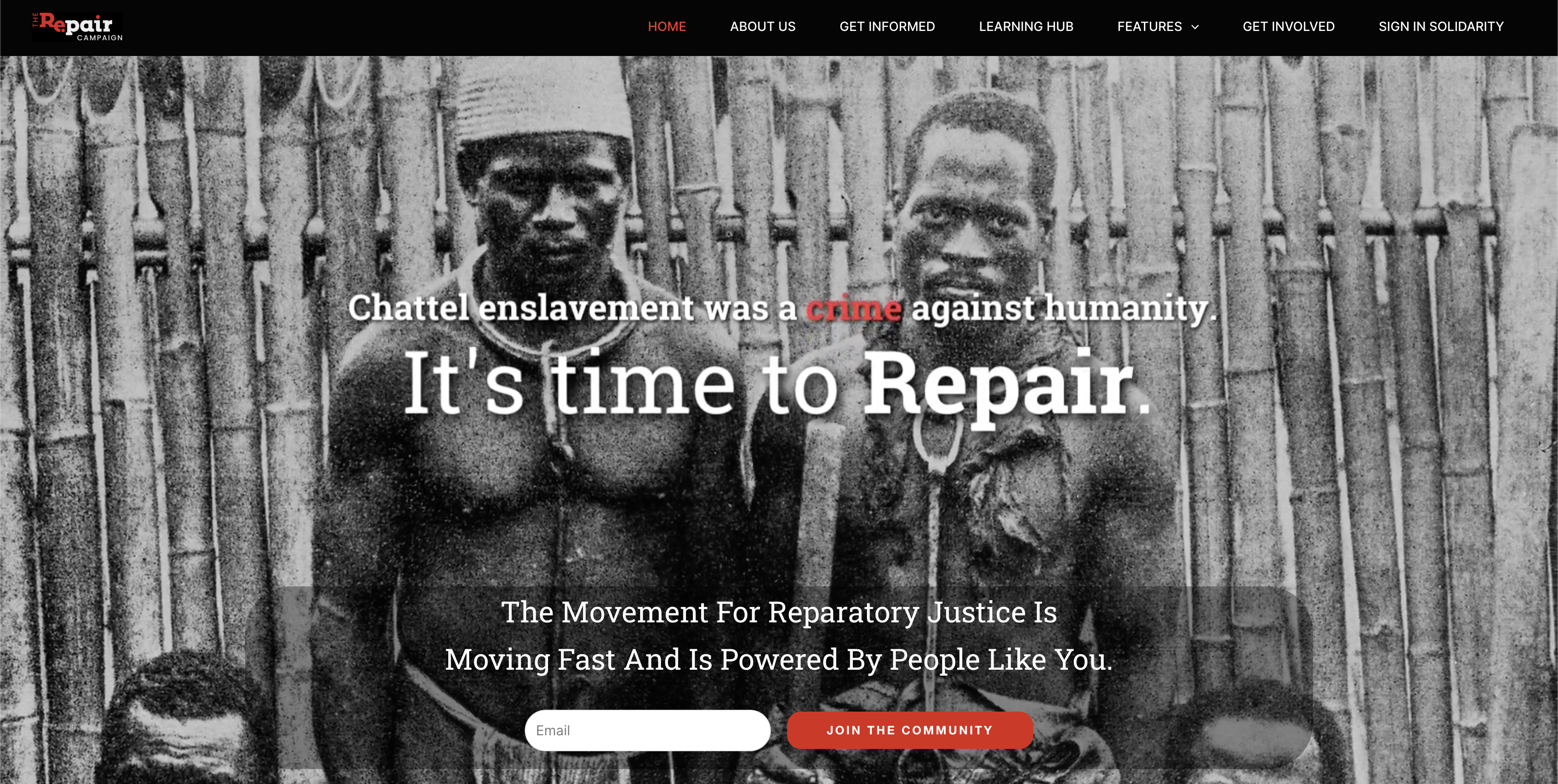
More than a website. A movement infrastructure.

Reparatory justice is a politically charged, historically dense topic. The site needed to do three things at once: inform newcomers encountering the movement for the first time, keep existing supporters engaged with fresh content, and convert both into active participants. Petition signatories, newsletter subscribers, people sharing the work.

The organisation had no in-house technical team. Whatever we built had to be completely self-sufficient. The client needed to be able to publish a breaking news article, embed an Instagram post, or update the timeline without sending us a message. Any developer dependency would have been a bottleneck for an organisation that moves at the speed of news cycles.

The design also had to carry weight. This isn't a topic where you can go generic. Every choice, from typography to the tone of the CTAs, had to reflect the gravity and legitimacy of the cause.

The thinking behind the build.

These are the decisions that shaped the project. Not just what we chose, but why.

01

WordPress + Elementor over a custom build

This was the foundational call, and it wasn't obvious. A custom React or Next.js build would have been faster and more flexible on paper. But it would have made the client dependent on us for every article, every page update, every embed.

WordPress with Elementor gave the team full editorial control. They can publish breaking news, edit layouts, add sections, and update content on their own timeline without a developer. We built it so they wouldn't need us day to day.

The right tool is the one that serves the client's long-term independence, not the one that keeps them coming back to you.

02

A historical timeline at the centre of the experience

The reparations movement is rooted in history. One of the biggest barriers to engagement is that the topic can feel too complex, too distant, or too contested to touch. A well-structured timeline, from the transatlantic slave trade through to current CARICOM negotiations, addresses that directly.

We put the timeline on the homepage, not buried in a sub-page. Two versions: a horizontal scrolling layout for desktop that creates a sense of progression through time, and a vertically stacked layout for mobile. The goal was to make history feel navigable. A path through complexity, not a wall of text.

03

Community-first architecture, not broadcast-first

Most advocacy websites default to broadcast mode. They publish and hope people read. The Repair Campaign needed something more active. Every page has a conversion point: a newsletter signup, a petition CTA, a path to Get Involved.

The Sign in Solidarity petition was raised to a primary navigation action, not buried in a page. The newsletter signup appears above the fold and again at the bottom of the homepage. The Instagram feed on the homepage isn't decoration. It shows the movement is live and growing right now. These are friction-reduction choices. Make it as easy as possible for a visitor to take a step, any step, toward participation.

A signature, a newsletter signup, a share. Each is a small commitment that builds toward a larger one. We designed for that ladder, not just for the reader.

04

Separating evergreen content from time-sensitive news

The site serves two audiences with very different expectations. A first-time visitor needs context: what is reparatory justice, why does it matter, what is the history? A returning community member wants the latest: which governments are moving, what was said at the last summit, what should they be sharing?

We structured the site for both. Get Informed and Learning Hub hold durable educational content designed to stay relevant regardless of the news cycle. In The News, Dive Deeper, and the newsletter serve the community's need for timely updates. The split also has an SEO benefit. The evergreen sections build long-term organic visibility around reparations search terms, while the news section keeps people coming back.

05

Instagram feed integration as a live pulse

The reparations movement is highly active on social. Political speeches, breaking news reactions, community updates all hit Instagram first. Embedding the feed on the homepage means the site feels alive even between formal blog posts.

It also cuts content management overhead. A single Instagram post automatically surfaces on the website. No duplication of effort, no lag. For an organisation running lean, that kind of workflow efficiency adds up.

06

Google Analytics 4 setup and custom dashboarding

Raw analytics data is noise. A dashboard built around the questions an organisation actually asks is signal. We set up GA4 across the site and built custom reporting dashboards showing the numbers that mattered: traffic sources, most-read content, petition page conversions, and the geographic spread of their audience.

That last point proved strategically useful. Knowing that significant traffic was coming from the UK, Jamaica, and Caribbean diaspora communities in North America and Europe helped the team focus their outreach and understand where the movement was resonating. The dashboards were built to be readable by the comms team, not data analysts. Clear, labelled, updated automatically.

Analytics only becomes an asset when the people running the organisation can actually read it. We built for the comms team, not for data analysts.

07

SEO structure and article posting strategy

Reparatory justice is an increasingly searched topic. Major events like CARICOM negotiations, parliamentary debates, and international advocacy milestones drive real search volume. We structured the site to capture that: clean URL slugs, properly configured meta descriptions, schema markup, and content hubs built around the long-tail keyword clusters a first-time searcher would actually use.

Beyond the technical setup, we established a regular posting cadence: monthly news roundups, event-driven articles, and newsletter editions that create a continuous stream of fresh, indexed content. Each new article is another entry point for organic search. Over time this compounded. The site built authority in the reparations topic area and traffic grew during news cycles as it ranked for relevant terms. The SEO work and the community architecture reinforced each other. Organic visitors arrived, found value, and converted into subscribers.

08

Duplicate content management

In a content-heavy WordPress site with multiple contributors covering fast-moving news, duplicate content builds up fast. Similar articles, reposted news items, overlapping topic pages. For most organisations this goes unnoticed. For SEO it's a quiet tax: Google splits ranking authority across duplicate URLs rather than consolidating it, so every duplicated piece dilutes the equity the site has built.

We audited existing content, identified duplicates and near-duplicates, and resolved them through consolidation, canonical tags, and removal where content was genuinely redundant. We also put a lightweight editorial process in place to stop it recurring. Simple enough that the team could follow it without thinking too hard about it.

09

Email design and campaign management

Email serves a different audience than social. The Repair Campaign's newsletter subscriber base skews toward more committed, older supporters: people who opted in explicitly and expect quality content. The design and experience of those emails matters.

We designed a branded email template system, header, body, feature blocks, footer, that matched the site's visual identity and held up across email clients. Beyond the template, we managed the ongoing send cycle: list management, subscriber segmentation, send scheduling, and performance tracking. Consistent, well-designed emails build trust over time in a way that sporadic generic ones don't. Every send reinforces that this organisation is serious and worth paying attention to.

10

Custom WordPress plugin: in-admin email scheduling

This was the most technically involved piece of the engagement. The team found that switching between WordPress, where they wrote content, and their email platform, where they scheduled sends, was creating delays and errors. Content would be ready but emails would go out late. Drafts would get out of sync between platforms.

We built a custom WordPress plugin that moved the scheduling step directly into the WordPress admin. The workflow became: write the newsletter post, set a send date and time in the same editor panel, publish. The plugin handles the rest: queuing the send, pulling the content into the email template, and dispatching at the scheduled time. No platform switching, no copy-pasting, no sync issues.

Building this as a plugin rather than recommending a third-party tool was a considered choice. Third-party scheduling tools add another subscription, another login, and another point of failure. A native plugin lives inside the system the team already uses every day.

The best tools disappear into the workflow. The team shouldn't have to think about the mechanism. Just write, schedule, done.

What shipped.

The final site has a content-rich homepage, dedicated hubs for news (In The News, Newsletter), education (Get Informed, Learning Hub, Dive Deeper), and community action (Get Involved, Sign in Solidarity). The petition integration and newsletter system were built into the architecture from the start, not added on afterwards.

repaircampaign.org
The Repair Campaign homepage

The site is fully responsive across all breakpoints. The mobile experience got particular attention given that a significant share of the audience engages from phones, especially from Caribbean and UK diaspora communities.

Where it landed.

Editorial independence achieved

The team publishes news, schedules emails, and manages all content from a single WordPress admin. Zero ongoing developer dependency.

Measurable traffic growth

The SEO structure and article posting cadence drove compounding organic growth, particularly during news events in the reparations space where the site ranked for relevant search terms.

Analytics-informed decisions

Custom GA4 dashboards gave the team clear visibility into audience geography, content performance, and conversion. Data the communications team could actually act on.

Streamlined email workflow

The custom scheduling plugin collapsed a multi-platform workflow into a single step inside WordPress. Newsletters go out on time, on brand, without tool-switching or sync errors.

Clean content architecture

Duplicate content auditing and canonical management protected the site's SEO equity as the content library grew. A sustainable editorial process prevents recurrence.

Active community platform

The petition, newsletter, and Instagram integration run continuously. As the global reparations conversation accelerates, the site is built to scale with it.

The Repair Campaign launched into a moment of growing global attention on reparatory justice, and the site has kept pace. It handles increased traffic during news events, grows its subscriber list, and serves as the organisation's primary digital home across the UK, Jamaica, and the diaspora.

The cleanest measure of success: since launch, the team has never needed to call us to make a content change.

Got a project
in mind?

We're always open to the right conversation.